Cloudy vs Green Pool Water: Clarifier, Shock or Algaecide?
Reaching for the wrong bottle costs you a week, so it helps to know which problem you're actually looking at.
October 27, 2026 · 4 min read
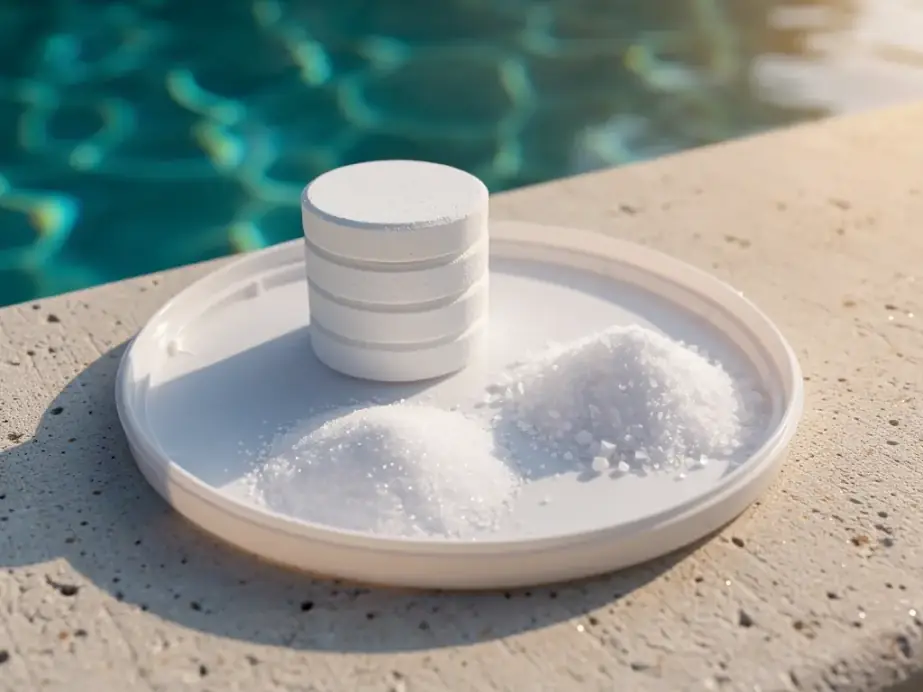
Every summer, somebody pours a jug of clarifier into a green pool and waits for a miracle. Somebody else shocks a pool that was only cloudy, then ends up with a bigger mess. Cloudy water and green water look like cousins, but they come from different causes and respond to different products. Once you know which one you're dealing with, the fix gets simple.
Cloudy water is a particle problem
Cloudy or milky water means tiny particles are floating around too small for your filter to catch. Those particles can be dust and pollen, dead algae, oils from sunscreen, minerals dropping out of solution or fine debris after a storm. A pool can be cloudy and still have healthy sanitizer, and that's why guessing doesn't work. The water looks bad, but nothing may be alive in it.
Common causes include a filter that isn't running long enough each day, a dirty or worn filter, pH and alkalinity that have drifted out of balance, and a heavy swim load. Georgia pollen season adds its own layer, and so do afternoon thunderstorms that blow leaves, dirt and red clay dust across the yard and into the water.
What clarifier actually does
Clarifier doesn't kill anything. It draws those microscopic particles together into clumps big enough for the filter to trap. That's all it does, and it does it well when the filter is clean and running. Products like SeaKlear and the clarifiers in the Natural Chemistry line work this way, along with other brands we carry on the shelf.
Clarifier works best after you've sorted out the cause. If your pH is way off or your sanitizer is low, adding clarifier is like mopping while the sink is still running. Check the water, balance what needs balancing, make sure the filter is clean, and run the pump for long stretches. Then let clarifier finish the job. Follow the label for the size of your pool, and don't double up because the water still looks hazy after an hour. It takes time to clump and filter out.
Green water is an algae problem
Green means algae, and algae means the sanitizer lost the fight. The water can run from pale lime to dark swamp, and walls often feel slick. Heat, sunlight, rain, low chlorine and weak circulation all help algae along. Green water calls for a different tool than cloudy water: something that kills.
Shock does the heavy lifting
Shock is a big dose of oxidizer. It raises the sanitizer level fast enough to wipe out algae, burn off combined chlorine and clean up the organic load that has been building. For a green pool, shock is almost always the first real step. Brush the walls and floor first so the algae is lifted into the water where the shock can reach it, then add shock according to the label for your pool volume, and run the pump around the clock until the water turns.
Shock works best in the evening, since sunlight eats chlorine quickly. And the test matters here. If the stabilizer, which protects chlorine from the sun, runs too high, chlorine can lose its punch and the pool keeps fighting you. A water test will show that before you spend money on the wrong thing.
Where algaecide fits
Algaecide is a helper. It can kill algae and slow its return, but it works as a partner to good sanitizer, not a replacement. Think of it as a second layer after shock, or as a preventive dose during hot, rainy stretches when algae gets pushy. Using algaecide alone on a seriously green pool tends to disappoint, because it doesn't have the oxidizing strength to clear a big bloom.
There are a few types of algaecide, and not all of them suit every pool. Ask which one fits your setup, particularly if you have a salt system or a colored liner, since some products can cause foam or staining.
The order that works
- Test the water first, so you know if it's pH trouble, low sanitizer or both
- Clean or backwash the filter, and empty the skimmer and pump baskets
- Brush the walls and floor, especially corners and steps
- Shock if the water is green, then run the pump continuously
- Add algaecide as backup if the bloom was heavy
- After the water turns from green to a dull gray or cloudy blue, which is dead algae, add clarifier and keep the filter running
- Retest and balance once the water clears
That cloudy stage right after a shock surprises people. The algae is dead but still floating, and the filter has to pull it out. Clarifier comes into its own at that point. It's also why a green pool often looks worse for a day before it looks better, and why a jug of clarifier on day one wouldn't have helped.
Skip the guessing and test first
Every one of these problems starts with the same question: what's actually going on in the water? Elite Pool Store tests water for free for all swimming pools. Bring a clean sample to 6337 US-19 in Zebulon and we'll tell you whether you need clarifier, shock, algaecide or none of the above. We carry chlorine, shock, clarifier, algaecides and salt, so you can usually pick up the right product while you're there. Hours are Monday through Friday 9 to 6 and Saturday 10 to 4, closed Sunday, and our number is (470) 945-4340.
Elite Pool Store, (470) 945-4340
Call (470) 945-4340More articles
How to Take a Pool Water Sample Worth Testing
Most confusing test results trace back to the sample, not the pool, and a few small habits fix that.
Signs Your Pool Pump Seal or Motor Is Going
Catching a leaking shaft seal early can save the motor, and a few details on the nameplate make the parts search quick.