Signs Your Pool Pump Seal or Motor Is Going
Catching a leaking shaft seal early can save the motor, and a few details on the nameplate make the parts search quick.
October 27, 2026 · 4 min read
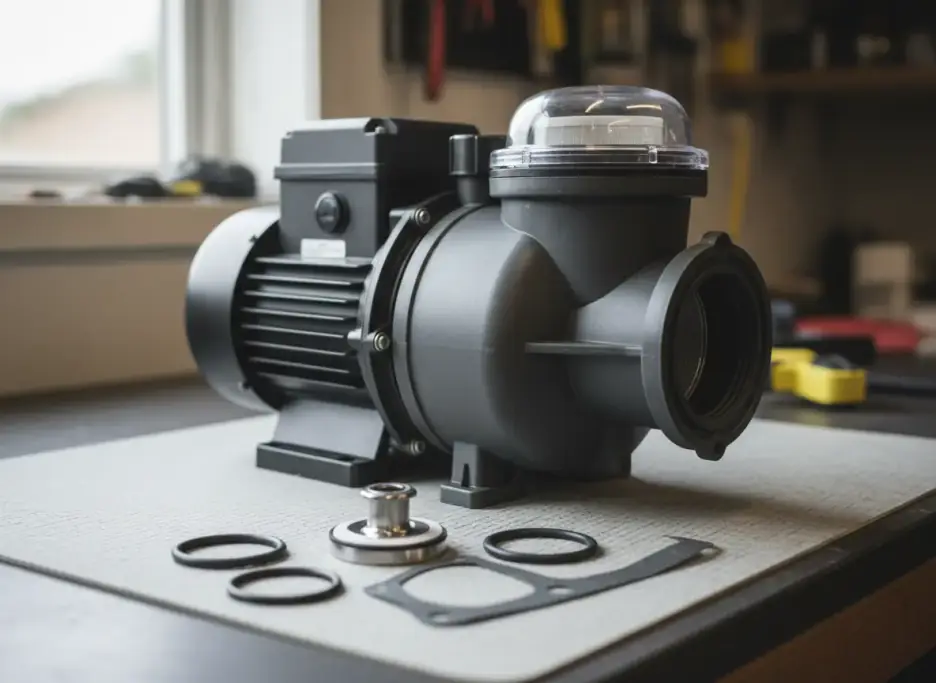
Your pool pump is the heart of the whole system. When it's healthy, you hardly think about it. When it starts to fail, it usually says so first with a drip, a noise or a smell. Catching those hints early can mean replacing a small seal instead of an entire motor. Here's what to look and listen for, and what to bring when you head to the store.
First, a note on safety
Water and electricity don't mix. Before you touch the pump, turn off the breaker that feeds it, not just the switch on the timer. Don't open a motor housing, handle wiring or reach inside the pump while the power is live. If you smell something burning or see scorched wiring, stop and shut the power off at the panel. A motor that's electrically damaged deserves a careful look before anyone runs it again.
A drip under the pump
The shaft seal sits between the wet end, where the water moves, and the motor. Its job is to keep water out of the motor bearings. Over time heat, dry running, and age wear that seal down. The classic sign is a slow drip or a wet spot where the motor meets the wet end of the pump, sometimes with a rust stain trail running down the shaft area. A small drip that comes and goes may be easy to ignore, but it's your early warning.
Water that gets past a bad seal will find the motor bearings, and bearings don't forgive. A seal kit is a small repair compared to a replacement motor, so a drip is worth chasing right away. Elite Pool Store carries pumps, motors and seal kits, along with parts for Hayward, Polaris, Pentair and Jandy equipment.
Squealing, grinding or a rough rumble
A healthy pump hums. A failing one squeals, screams, grinds or rumbles. A high-pitched screech often points to worn bearings, particularly if it starts as soon as the pump kicks on. A grinding or gravelly sound can come from the bearings too, or from debris and a damaged impeller in the wet end. Either way, the noise is a message. Running a noisy pump for weeks usually turns a fixable problem into an expensive one.
Humming but not turning
If the motor hums and the shaft doesn't spin, something is stuck or the motor can't start. It could be a failed capacitor, seized bearings or a jammed impeller. Cut the power first. If the shaft is stuck, don't keep trying to start it, since a motor that can't turn will heat up quickly and may trip the breaker over and over.
Tripping breakers and hot motors
A breaker that trips when the pump starts is telling you the motor is working too hard or has an electrical fault. A motor case that's too hot to touch is another bad sign, especially if it smells like hot metal or varnish. Heat is the enemy of motor windings. If the pump sits in a closed-in spot with poor airflow, give it room to breathe. If the heat keeps coming back, the motor might be on borrowed time.
Air bubbles and lost prime
A stream of bubbles at the returns, a pump basket that never fills with water and a pump that struggles to prime can come from a seal that lets air in, a cracked lid or a bad O-ring. Not every air leak is the shaft seal, which is why it helps to look at the whole suction side. Check the lid, the O-ring on the lid and the unions before you blame the motor.
What to bring to the store
You can save yourself a second trip with a little preparation. Most of what we need is printed right on the pump and motor:
- The brand and model number from the pump label
- The nameplate on the motor, which usually lists horsepower, voltage and frame details
- A few clear photos of the pump, the motor and the area where it's leaking
- The old seal, if you've already taken the pump apart, so we can match it by eye
- Notes on what you heard or saw, and how long it's been going on
If you can only bring one thing, bring the model number. Pumps from different makers look alike, and a seal that's close but wrong won't hold. A photo of the nameplate is enough if you can't remove the pump.
Seal, motor or whole pump?
If the problem is a drip and the motor still spins quietly, a seal kit might be all you need. If the bearings are loud or the motor is overheating, a new motor may make more sense. If the housing is cracked or the pump is very old, replacing the whole unit can be the better call. We'd rather talk it through with you than sell you more than the pool needs.
Bring your details and your questions to Elite Pool Store at 6337 US-19 in Zebulon, open Monday through Friday 9 to 6 and Saturday 10 to 4. Call (470) 945-4340 if you'd like to ask about a part before you make the drive. And if the water itself has been acting up, we test it for free while you're in.
Elite Pool Store, (470) 945-4340
Call (470) 945-4340More articles
How to Take a Pool Water Sample Worth Testing
Most confusing test results trace back to the sample, not the pool, and a few small habits fix that.
Cloudy vs Green Pool Water: Clarifier, Shock or Algaecide?
Reaching for the wrong bottle costs you a week, so it helps to know which problem you're actually looking at.